The Data Fracture: Why Inconsistent N.A.P. Data is The Silent Killer of Rankings
Your business might be invisible because of a typo. We explain the 'Knowledge Graph,' how Google loses trust when 'St.' vs 'Street' doesn't match, and the audit protocol we use to fix it.
In the world of digital marketing, we tend to obsess over the “loud” variables. We obsess over the design of the website, the creative copy in the ad, and the number of 5-star reviews.
But there is a silent variable that often matters more than all of those combined. It is a variable that operates in the background, invisible to the human eye but glaringly obvious to the algorithm.
That variable is Data Consistency.
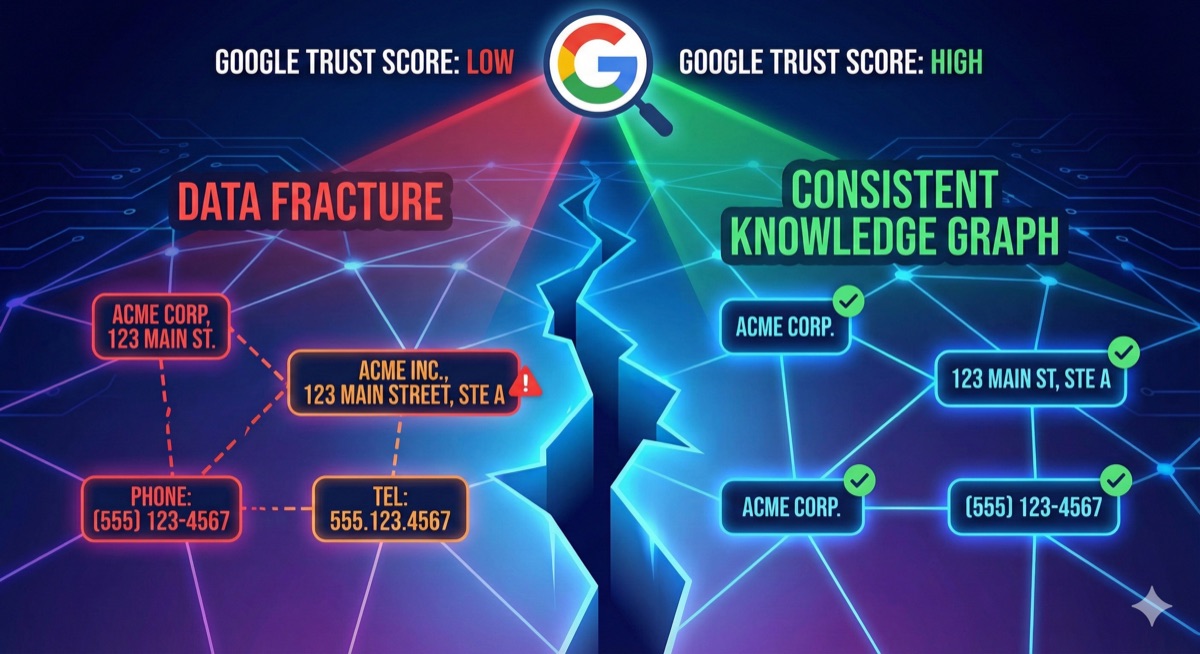
You could have the most beautiful website in your city and the highest budget for Google Ads. But if your Facebook page lists your address as “123 Main St.” and your Google Business Profile lists it as “123 Main Street, Suite A,” you have a problem.
To you, those look like the same address. To a human customer, they look like the same address.
To the Google algorithm, they look like two different entities.
We call this a Data Fracture. It is the single most common reason why established, reputable businesses fail to rank in the Local Map Pack. Today, we are going to break down the science of the “Knowledge Graph” and explain why a typo might be costing you six figures a year.
Understanding the “Knowledge Graph”
To understand why N.A.P. (Name, Address, Phone) consistency matters, you have to understand how Google “thinks.”
Google is not a person. It does not “know” your business exists. It relies on a database structure called the Knowledge Graph. This is a massive web of data points that connects entities (businesses) to attributes (locations, hours, services).
When Google crawls the web, it is constantly looking for corroborating evidence to confirm that your business is real and trustworthy. It looks at:
- Your Website
- Your Google Profile
- Your Facebook/LinkedIn
- Data Aggregators (like Yelp, YellowPages, Apple Maps)
- Government filings
It compares the data points across all these sources to generate a Confidence Score.
The Confidence Score Equation
If Google sees “Acme Consulting” at “100 Broadway” on every single platform across the internet, its Confidence Score is 99%. It trusts that you are real, and it feels safe recommending you to a user.
However, if it sees:
- Google: Acme Consulting Group, 100 Broadway
- Facebook: Acme Consulting, 100 Broadway, Ste 200
- Yelp: Acme Grp, 100 Broadway
Google’s Confidence Score drops. It detects a “Fracture.” It thinks, “I am not 100% sure these are the same business. If I send a user here, they might get lost.”
Because Google’s primary product is User Experience, it will always prioritize the business with the higher Confidence Score—even if that business is smaller or newer than yours.
The Butterfly Effect of Bad Data
This issue affects every industry, from law firms and medical practices to retail stores and SaaS companies with local HQs.
Here is why it is the “Silent Killer”: Google does not notify you when your data is fractured.
You don’t get an email saying, “Hey, your Yelp listing is missing ‘LLC’ so we are demoting you.” You just slowly disappear from the rankings. You drop from position #1 to position #4. The phone rings a little less.
You assume it’s the economy. You assume it’s your competitors. But in reality, it’s often just messy data.
Common sources of Data Fractures include:
- Rebranding: You changed your name three years ago but forgot to update a directory listing from 2018.
- Moving Offices: You updated your website, but Apple Maps still lists your old suite number.
- Phone Tracking: You used different tracking numbers for different campaigns, confusing Google about which phone number is the “real” one.
- Abbreviations: Using “St.” vs “Street” or “Co.” vs “Company” inconsistently.
The Audit Protocol: How We Fix It
Repairing a Data Fracture requires a surgical approach. We don’t guess; we use a specific protocol to align your digital footprint.
This is the core of our Profile Optimization Service.
Step 1: The “Source of Truth” Determination
First, we have to decide exactly how your business should appear. This sounds simple, but it requires precision.
- Is it ”&” or “and”?
- Is the suite number on Line 1 or Line 2?
- Are we using the legal name or the DBA?
We establish a Master Data Set that serves as the Source of Truth.
Step 2: The Aggregator Sweep
We don’t just fix your Google Profile. We use API tools to scan the major “Data Aggregators” (the databases that feed smaller directories). We locate every instance of your business on the web—from major platforms like Bing and Apple Maps to niche industry directories.
We identify the outliers and force a sync with the Master Data Set.
Step 3: Attribute Expansion
Once the baseline data (N.A.P.) is consistent, we look for opportunities to expand your presence in the Knowledge Graph.
Most businesses only fill out the basic fields. We go deeper.
- Service Attributes: Does your law firm offer “Video Consultations”? Is your retail store “Wheelchair Accessible”?
- Category Specificity: Are you just a “Dentist,” or are you also a “Cosmetic Dentist” and a “Dental Implant Periodontist”?
By toggling these specific attributes, we give Google more “hooks” to grab onto when users search for specific needs.
The Result: Authority
When your data is pristine, Google’s trust in your entity skyrockets. The “Fracture” heals.
Suddenly, the algorithm views you as the definitive authority in your area. This doesn’t just help with rankings; it protects you. A business with a high Confidence Score is harder for competitors to displace.
Data hygiene isn’t the “sexy” part of marketing. It’s not a viral video or a Super Bowl ad. But it is the foundation that everything else is built on. If the foundation is cracked, the house will eventually sink.
Is your data helping you or hurting you? Don’t guess. Let us audit your digital footprint and fix the fractures before they widen.