Beyond the Kickback: Building a Resilient Local Referral Ecosystem
Stop chasing cold leads. Learn the scientific approach to building organic, community-driven local partnerships that generate consistent referrals, and the exact systems to track and reward them.
If you run a brick-and-mortar or service-based business locally, you know the exhaustion of the digital treadmill. You are constantly feeding the Facebook Ad beast, battling for SEO scraps against national competitors, and trying to shout over the noise of ten thousand other businesses vying for attention on Instagram.
It is expensive, it is exhausting, and often, the leads it generates are “cold”—skeptical price-shoppers with zero loyalty.
But there is a parallel economy operating right underneath the digital noise. It’s quieter, vastly more profitable, and resilient to algorithm changes.
It’s the Local Web of Trust.
Think about the last time you needed a trustworthy mechanic. Did you click the first Google Ad you saw, or did you ask your friend who they use? When you needed a CPA, did you trust a Facebook banner, or did you ask your business attorney for a recommendation?
The highest quality leads—the ones who convert faster, spend more, and stay longer—almost always come via referral.
Yet, most local businesses treat referrals as a happy accident. They hope they happen, but they have no system to engineer them.
In our laboratory, we don’t rely on hope. We rely on systems.
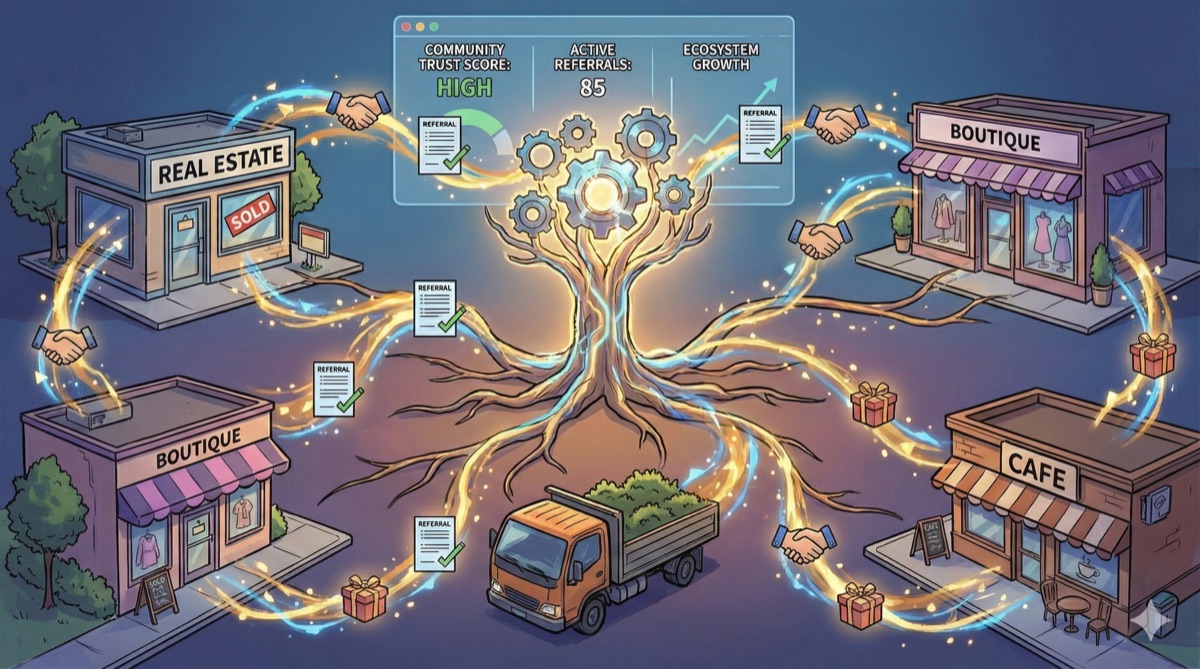
Building a local referral ecosystem isn’t about slimy backroom handshake deals or desperate networking events. It’s about architecting a community of complementary businesses aligned around a shared customer profile.
Here is the blueprint for building, tracking, and maintaining a high-performing local partnership network.
Phase 1: The Mindset Shift—From Transactional to Ecological
Before we talk about tracking software or payout percentages, we have to fix the foundational flaw in how most people approach partnerships.
Most business owners approach a potential partner like a vampire looking for a vein. Their mindset is: “You have customers I want. Give them to me, and I’ll throw you a few bucks.”
This is purely transactional. It feels gross to the partner, and it eventually feels gross to the customer being “sold off.” These arrangements rarely last because as soon as the transaction stops feeling equal, the relationship dies.
The Ecological Approach
To build something sustainable, you must stop thinking like a hunter and start thinking like an ecologist.
In a healthy local ecosystem, businesses aren’t just adjacent; they are symbiotic. They feed into one another. The success of one elevates the success of the other.
Your goal is to identify businesses where a referral to you actually improves their relationship with their client.
If a high-end real estate agent refers their client to a shoddy moving company, that agent’s reputation is damaged. But if they refer their client to the best, most white-glove moving service in town, the agent looks like a hero. The referral wasn’t a transaction; it was a service extension.
The Golden Rule of Partnerships: You must add more value to the partner’s ecosystem than you extract in leads.
Phase 2: Mapping Your Local Customer Journey
How do you find these symbiotic partners? You have to step outside your own business and map the entire life cycle of your ideal customer.
Don’t just look at who they are; look at when they are.
Customers usually need services in sequences. If you can identify who serves your customer immediately before they need you, and immediately after they need you, you have found your golden partners.
The “Before and After” Exercise
Let’s define the different tiers of partnerships based on a theoretical customer journey. Let’s say you own a high-end local landscaping design firm.
1. Upstream Partners (They see the customer before you)
These are the most valuable partners because they catch the customer right as the need is emerging.
- The Real Estate Agent: They just sold a house that needs curb appeal.
- The Custom Home Builder/Architect: They are designing the structure and need the outdoors to match.
- The Pool Installation Company: They are tearing up the yard and know the client will need it put back together beautifully.
2. Downstream Partners (They see the customer after you)
You can provide immense value to these partners by referring your finished clients to them.
- The Lawn Maintenance Crew: You design and build it; these guys keep it alive weekly.
- The Outdoor Furniture Boutique: You built the patio; now they need to furnish it.
3. Lateral Partners (Same customer, different need)
- The High-End Interior Designer: They serve the same affluent clientele who value aesthetics, just inside the house instead of outside.
Action Step: Take 30 minutes and draw this map for your business. Who is upstream? Who is downstream? Identify 5-10 specific local businesses that fit these profiles.
Phase 3: The Organic Outreach (The “Anti-Sales” Pitch)
You have your list. Now, how do you approach them without sounding like you’re just asking for leads?
Do not send a cold email asking to “grab coffee and pick your brain.” Successful local business owners are busy; they don’t have time to have their brains picked.
Your outreach must be led with overwhelming value and curiosity about their business.
The “Value-First” Coffee Framework
When you meet, your entire goal is to understand their friction points.
Ask questions like:
- “Who is your absolute dream client, and how do you usually find them?”
- “What’s the biggest frustration your clients express to you immediately after you finish your work with them?” (This identifies gaps you might fill).
- “We share a very similar clientele. I’m looking for a trusted partner I can send my clients to when they need [their service]. Are you currently taking on new referrals?”
Notice what you did there? You didn’t ask for referrals. You offered them.
You are auditioning them to see if they are good enough for your customers. This flips the dynamic and positions you as a peer with high standards, not a beggar looking for scraps.
Once trust is established, propose a small, low-risk experiment. “Let’s try this for 90 days. We’ll set up a simple system to introduce each other to clients where it makes sense, and see if we can’t improve the experience for both of our customer bases.”
Phase 4: The Science of Tracking—Moving Beyond the Spreadsheet
If you don’t track it, it isn’t real.
The fastest way to kill a partnership is ambiguity. If Partner A sends ten leads, and Partner B only “thinks” they got two of them, resentment builds. You need a “single source of truth” that shows exactly who sent what, and what that lead turned into.
The complexity of your system depends on your volume and technical comfort.
Level 1: The “Low-Tech” Bridge (Good for starting)
You don’t need expensive software to start. You need a standardized intake form and a shared view.
- Tools: Jotform (or Typeform) + Google Sheets + Zapier.
- The System:
- Create a simple, private web form for your partner. It asks for the lead’s info and, crucially, a hidden field indicating which partner is using the form.
- Give the partner the link. They bookmark it on their phone.
- When they are standing with a client who needs you, they open the form, type in the info, and hit submit.
- Zapier instantly fires that data into your CRM and into a shared Google Sheet that the partner can view.
- Why it works: The partner gets instant confirmation the lead was sent. They can check the Google Sheet to see the status (e.g., “Contacted,” “Sold,” “Project Complete”). Transparency breeds trust.
Level 2: CRM Tagging and Attribution (Intermediate)
If you are already using a robust CRM like HubSpot, ActiveCampaign, or HighLevel, lean into it.
- The System:
- Create unique “referral links” for each partner using UTM parameters (e.g.,
yourwebsite.com/contact?utm_source=partner&utm_medium=referral&utm_campaign=john_doe_realty). - When a lead uses that link, your CRM automatically tags the contact record as “Referred By: John Doe Realty.”
- Build a dashboard report that shows revenue generated segmented by referral source tag. This allows you to see exactly how much money a specific partner has brought you over time.
- Create unique “referral links” for each partner using UTM parameters (e.g.,
Level 3: Dedicated Partner Relationship Management (PRM) (Advanced)
If you are scaling this to dozens of partners and managing complex payouts, you need dedicated infrastructure.
- Tools: PartnerStack, Rewardful, or Everflow.
- The System: These platforms give your partners their own login portal. They can grab tracking links, view their own dashboard of referred leads, see the status of those leads in real-time, and view their accumulated commissions. It automates the entire tracking and payout process.
Phase 5: Navigating Payouts—Revenue, Ethics, and Red Tape
This is where the rubber meets the road, and where things get sticky. How do you reward the partner?
There is no single answer. It depends heavily on your industry, margins, and local laws.
The Legal Disclaimer (Crucial!)
Before implementing any financial kickback system, you must verify regulations in your specific industry and state.
- Real Estate (RESPA): In the US, the Real Estate Settlement Procedures Act (RESPA) has incredibly strict rules preventing kickbacks for federally related mortgage loans. You generally cannot pay a Realtor cash just for sending a name.
- Finance & Insurance: Highly regulated regarding referral fees.
- Medical/Legal: Often have strict ethical codes against fee-splitting.
If you are in a regulated industry, your “payout” cannot be transactional cash. It must be built on mutual value-add, cross-promotion, or non-monetary gifts that fall within ethical guidelines. Always consult your attorney.
The Unregulated Models (For everyone else)
If you are a landscaper, a gym owner, or a photographer, you have more freedom. Here are common structures:
1. The Flat Bounty (CPA - Cost Per Acquisition)
Simple and clean.
- “For every qualified lead you send that books an appointment, we send you $50.”
- “For every referral that becomes a paying client, we send you $250.”
- Pros: Easy to calculate, instant gratification for the partner.
- Cons: Doesn’t account for the value of the client. A $250 payout on a $500 job hurts; on a $50,000 job, it’s cheap.
2. The Revenue Share Percentage
The fairest model for high-ticket services.
- “We pay out a 10% referral fee on the gross revenue of the first project booked by the referred client.”
- Pros: Perfectly aligns incentives. The bigger the job they send, the more they make.
- Cons: Requires total financial transparency. You have to show the partner the final invoice amount so they know they are getting their fair share. You also need to decide if you pay on booking or on payment collected. (Always choose payment collected).
3. The “Value Loop” (Non-Monetary)
Often the most organic and sustainable method locally. Instead of cash, you trade value.
- The Barter: “You send your gym members to my smoothie shop for a discount; I provide free smoothie samples at your Saturday bootcamps.”
- The Gift Economy: Instead of a cold check, send a high-value, thoughtful gift basket to their office every time a major deal closes. It gets noticed by their whole team and fosters goodwill that cash sometimes cheapens.
The Payout Ritual
Whatever model you choose, execute it with clockwork reliability. Do not make partners chase you for their rewards.
If you are using a manual system, set a recurring calendar task for the 1st of the month: “Audit referrals and process payouts.” Send a report along with the payment showing exactly what it is for.
Reliability is the currency of trust.
Conclusion: The Resilient Economy
Building a local referral ecosystem is hard work upfront. It requires emotional intelligence, strategic mapping, and operational discipline. It is much faster to just turn on Facebook ads today.
But ads are a faucet. The moment you stop paying the water bill, the flow stops completely.
A partnership ecosystem is a well. It takes time to dig, but once you hit the water table, it provides a sustainable, high-quality source of life for your business that competitors can’t easily replicate.
Stop trying to shout louder than the internet. Start whispering to the right people in your own backyard.