Guerrilla Trust: Why Handshakes Still Beat Algorithms in 2026
In an era of peak 'Digital Fatigue,' the most disruptive marketing strategy is stepping away from the screen. We explore why high-friction, real-world pop-up activations are the lowest-cost method for building long-term brand fame and retention.
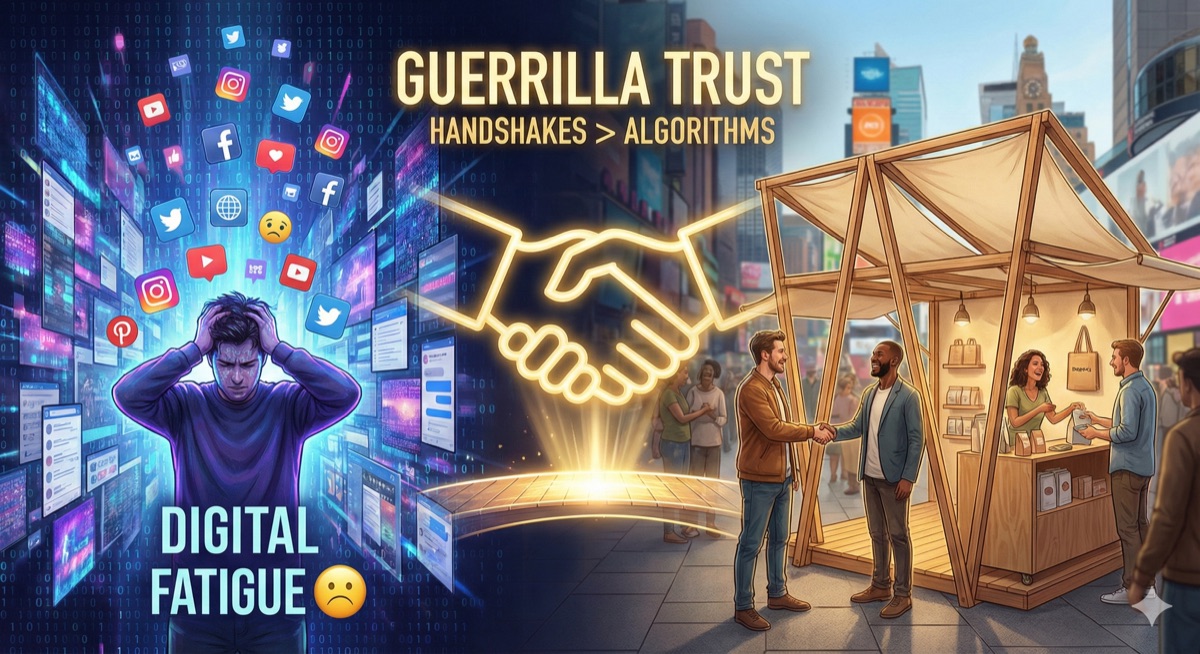
We have reached peak efficiency.
In 2026, you can target a left-handed CEO interested in sailing living in zip code 10011 with a personalized video ad delivered to their watch at 8:03 AM. The algorithmic targeting capabilities available to modern businesses are miracles of engineering.
Yet, despite this unprecedented efficiency, marketing feels harder than ever. Customer Acquisition Costs (CAC) are at all-time highs. Brand loyalty is at all-time lows. We are spending more money to reach fewer people who care less.
Why? Because we have hit the ceiling of digital scalability. We are facing a crisis of Digital Fatigue.
Your customers are not just ignoring ads; their brains are actively rewiring to filter them out. They exist in a state of continuous partial attention, doom-scrolling through a deluge of content where nothing sticks.
In this environment, the most radical, disruptive growth strategy isn’t a better Facebook ad. It isn’t a smarter AI chatbot.
It is a handshake.
At Artists Are Scientists, we believe that while algorithms are great at optimizing transactions, they are terrible at building trust. Trust requires a physical reality. This post explores the science of “Guerrilla Trust” and why high-friction, real-world Pop-Up Activations are the antidote to digital burnout.
The Neuroscience of “Pattern Interrupts”
Why do you remember the time a Red Bull car handed you a free drink on campus ten years ago, but you can’t remember the YouTube pre-roll ad you saw ten minutes ago?
The answer lies in how the human brain encodes memory.
Digital advertising is uni-sensory. It is just pixels on a flat screen, usually consumed while the user is distracted. The brain categorizes this as “low-priority noise” and flushes it almost immediately.
A physical experience is multi-sensory. It involves sight, sound, touch, and sometimes taste or smell. It requires navigation through 3D space.
When a brand manifests in the real world—a pop-up shop on a busy street corner, an exclusive networking lounge at a conference, a branded installation in a park—it creates a Pattern Interrupt.
It breaks the mundane cycle of the day. The brain snaps to attention. Because multiple senses are engaged simultaneously, the experience is encoded deeply into long-term memory. You aren’t just seeing the brand; you are occupying space with it.
A digital ad buys an impression. A physical activation buys a memory.
Rethinking Friction: Why “Harder” is Better
For the last decade, the obsession in tech has been the removal of friction. One-click ordering. Instant checkout. Seamless everything.
We have become so obsessed with removing friction from the transaction that we removed friction from the relationship.
In human psychology, friction—effort, time, physical presence—signals value. If something is too easy to obtain, it is perceived as cheap.
- Low Digital Friction: Clicking an ad takes 0.4 seconds and zero effort. The commitment is nil. The trust established is near zero.
- High Physical Friction: Driving to a pop-up event, finding parking, and walking inside takes 30 minutes and genuine effort.
When a prospect expends energy to engage with your brand in the real world, they are demonstrating a massive psychological commitment. They have skin in the game.
This “sunk cost” of effort makes them significantly more receptive to your message. A 5-minute conversation with a prospect who drove to meet you is worth 5,000 impressions targeting them on LinkedIn.
The Exposure Ladder: The New Math of ROI
CFOs and data-driven marketers often struggle with experiential marketing because the metrics look different. “How do I track the ROI of a sidewalk tent?”
If you measure it against the Cost Per Thousand Impressions (CPM) of a banner ad, physical looks expensive. But if you measure it against the Cost of Trust, physical is dirt cheap.
We visualize this using The Exposure Ladder:
- The Glance (Digital Ad): They see you for 0.4 seconds. Trust increase: 0.01%.
- The Hold (Direct Mail): They hold your mailer for 5 seconds before recycling. Trust increase: 1%.
- The Meet (Physical Activation): They interact with your team, demo your product, or shake your hand for 3-10 minutes. Trust increase: 500%+.
You can spend six months nurturing a lead with email drip campaigns to achieve the same level of trust you can build in a five-minute face-to-face interaction.
When you factor in the lifetime value (LTV) of a customer gained through a high-trust environment, the ROI of experiential marketing often dwarfs digital channels. These customers churn less, spend more, and become vocal advocates.
Executing Guerrilla Trust Across Industries
This is not just for B2C sneaker brands dropping limited editions. This applies to every business sector.
The B2B SaaS Play
Instead of spending $50,000 on a generic booth in a giant expo hall, rent a coffee shop across the street from the convention center. Rebrand it for the day. Offer free, high-quality coffee to anyone with a conference badge.
You become the “insider” secret. The conversations you have over lattes away from the chaotic expo floor will be higher quality than any lead scanned at a booth.
The E-Commerce Play
If you are a digital-native brand, your customers only know you as a URL. A temporary “showroom” pop-up allows them to touch the fabric, smell the candle, or try on the watch. You bridge the gap between digital promise and physical reality.
Crucially, you can use QR Code Campaigns in the physical space to track exactly who visited and attribute subsequent online purchases back to the pop-up event.
The Professional Services Play
A law firm or consultancy shouldn’t do a “pop-up shop,” but they should do exclusive, high-touch gatherings. A private scotch tasting for 20 key prospects is an “activation.” It’s a curated physical environment designed to build deep relational equity.
Conclusion
We are not suggesting you abandon digital marketing. Digital is essential for reach and frequency.
But digital is no longer sufficient for depth.
As the online world becomes noisier, more synthetic, and more AI-generated, the value of authentic, physical reality increases. In 2026, the most rebellious, effective thing a brand can do is show up in the real world and look a customer in the eye.
The algorithms are tired. It’s time to get back to basics.