The Sentiment Shield: How to Automate 5-Star Reviews (And Intercept the 1-Star Ones)
Business owners fear asking for reviews because of the dreaded 1-star bomb. This is a technical breakdown of 'Review Gating' logic—how to build an automated system that routes happy clients to Google while sending unhappy ones to a private feedback loop.
There is a specific notification sound on your phone that makes every business owner’s stomach drop.
It’s the “New Google Review” alert.
Whether you run a law firm, a boutique, a gym, or a SaaS company, this notification is Russian roulette. It could be a glowing 5-star testimonial that lands you your next big contract. Or, it could be a blistering 1-star rant from a client you thought was happy, permanently staining your digital reputation.
This fear of the “1-star bomb” paralyzes business owners. It stops them from asking for reviews entirely.
The result? A stagnant Google Business Profile. You deliver excellence every day, but your online presence doesn’t reflect it. You are suffering from a phenomenon we call Sentiment Imbalance.
Happy clients are quiet. Angry clients are loud.
If you leave your reputation to chance, the loud minority will define your brand.
At Artists Are Scientists, we don’t believe in chance. We believe in engineered systems. In this post, we are going to break down the mechanics of the “Sentiment Shield”—an automated protocol that maximizes your 5-star intake while intercepting negative feedback before it ever hits the public internet.
The Psychology of the “Ask” (And Why Humans Fail At It)
Before we get into the technology, we have to understand why manual review gathering fails across all industries.
You tell your account managers, “Make sure to ask the client for a review after the project closes.” Or you tell your cashier, “Ask them to review us on the receipt.”
Do they do it? Maybe 20% of the time. It feels awkward. They are busy. They just want to move to the next task.
When they do ask, the customer says, “Sure thing! I’ll do it later.” Do they do it? Almost never. Once they leave your store or close the Zoom call, life takes over. They forget.
Relying on humans to gather data is a flawed strategy. It is inconsistent, uncomfortable, and has a high rate of failure. To solve this, we must remove the human element from the “delivery mechanism” and replace it with automation.
We need a system that asks every customer, every time, at the exact moment of peak satisfaction.
The Technical Architecture of a “Sentiment Shield”
A Sentiment Shield is not about tricking Google. It is about creating a better customer experience (CX) that just happens to benefit your SEO.
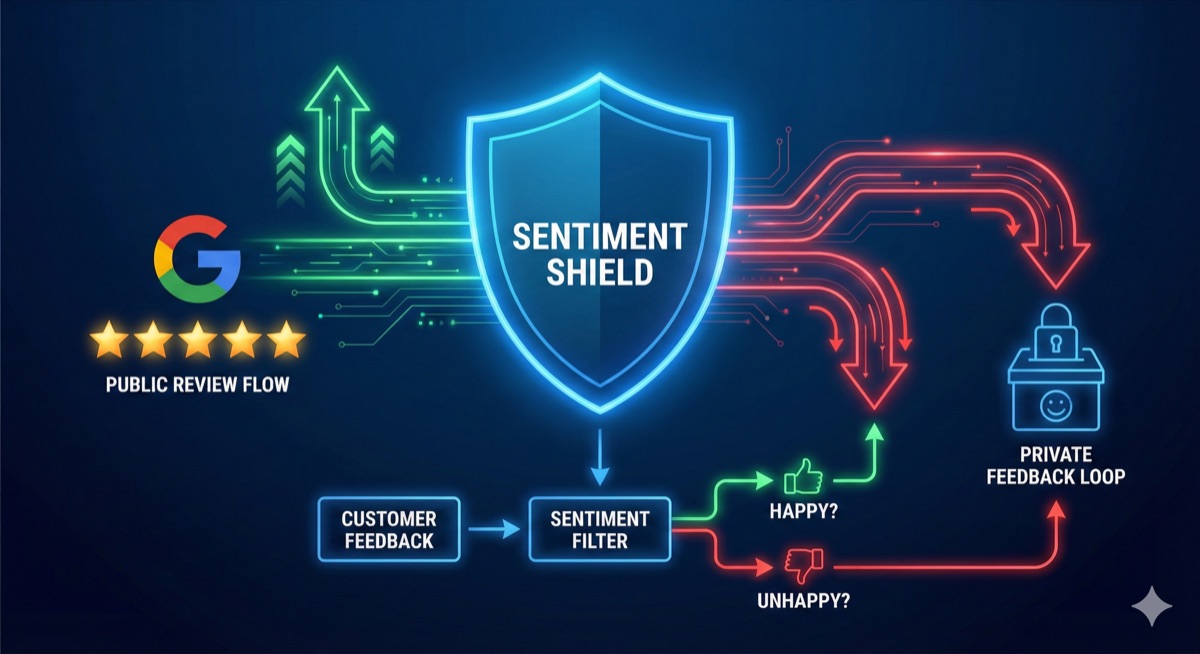
It works by inserting a Logic Gate between the customer and Google Maps.
Instead of sending a direct link to your Google review form (which is risky), we send the customer to an intermediate landing page controlled by us. This page asks a simple, internal diagnostic question.
The customer’s answer to that diagnostic determines their path.
Here is the step-by-step breakdown of the protocol:
Step 1: The Trigger (API Integration)
Automation requires a trigger. We integrate our system with your operational software—whether that is a POS system (Square/Toast), a CRM (Salesforce/HubSpot), or a project management tool.
When a transaction is “Completed” or a project is marked “Closed,” it fires a webhook to our system. This ensures the “ask” happens immediately after value delivery, when the client’s memory is fresh and gratitude is high.
Step 2: The Drip (SMS or Email Priority)
We send the request via the most appropriate channel for your industry. For most B2C businesses, SMS works best (98% open rate). For B2B/Professional Services, email is often preferred.
The message is short, polite, and neutral:
“Hi [Name], thanks for trusting [Company Name]. We enjoyed working with you on this project. Would you mind taking 10 seconds to rate your experience?”
It does not say “Review us on Google.” It says “rate your experience.” This is crucial phrasing.
Step 3: The Logic Gate (The Internal Landing Page)
When they click the link, they land on a mobile-optimized page with your logo and a simple question:
“How would you rate our service?”
Below it, they see either a 1-5 Star selection or a simple “Thumbs Up / Thumbs Down” interface.
This is the moment of truth. This is the shield.
Path A: The “Green Route” (Sentiment: Positive)
If the client clicks 4 or 5 stars (or Thumbs Up), the system identifies them as a Promoter.
The logic gate immediately executes a redirect. The page changes to say:
“We are thrilled to hear that! It would help us tremendously if you could share that experience on Google.”
A button appears that links directly to your Google Business Profile review form, pre-filled with 5 stars. We have removed all friction. They just have to type a sentence and hit post.
Result: A verified 5-star public review.
Path B: The “Red Route” (Sentiment: Negative)
If the client clicks 1, 2, or 3 stars (or Thumbs Down), the system identifies them as a Detractor.
This is where the magic happens. The logic gate does not send them to Google.
Instead, it reveals an internal text box on the same page:
“We’re sorry to hear that. We strive for excellence. Please tell us what went wrong so our management team can fix it immediately.”
When they type their complaint and hit submit, that data does not go public. It is routed directly to your internal leadership team via email or a Slack alert.
Result: A crisis averted. You received valuable operational feedback that allows you to improve your product or service, and you kept a damaging 1-star rant off your permanent record.
Why This Isn’t “Cheating”
Some business owners worry that this process is unethical.
It is important to understand the nuance. Google is against “Review Gating” where you prevent someone from leaving a bad review.
A well-designed Sentiment Shield does not prevent them. If a customer is determined to go to Google Maps manually and leave a 1-star review, they can. We cannot stop them.
What we are doing is guiding the path of least resistance.
We are offering an olive branch to unhappy clients. Most reasonable people don’t want to destroy your business publicly; they just want to feel heard. By providing an immediate, private channel for their frustration, you de-escalate the situation. You are providing better customer service.
If you resolve their issue privately, you can often turn that Detractor into a Promoter later.
The SEO Impact: Velocity and Recency
Beyond protecting your reputation, this system is a massive SEO driver for any local or regional business.
Google’s algorithm craves two things regarding reviews:
- Velocity: How frequently are you getting new reviews?
- Recency: How old is your newest review?
A consultant or retailer with 100 reviews from 2022 will be outranked by a competitor with 50 reviews who gets 2 new ones every week.
Google wants proof of life. They want to know you are currently active and currently satisfying customers.
By automating the ask on every single closed transaction, you create a consistent, predictable stream of fresh content for your profile. This is a massive signal of authority to the search engine.
Conclusion: Stop Playing Defense
If you are operating without a Review Automation system, you are fighting with one hand tied behind your back. You are letting the negative outliers dictate your public perception while your happy majority stays silent.
The Sentiment Shield is about taking control of the narrative. It involves using technology to filter the noise, amplify the positive, and learn from the negative in a safe environment.
Don’t wait for the next 1-star bomb to drop. Build the shield now.