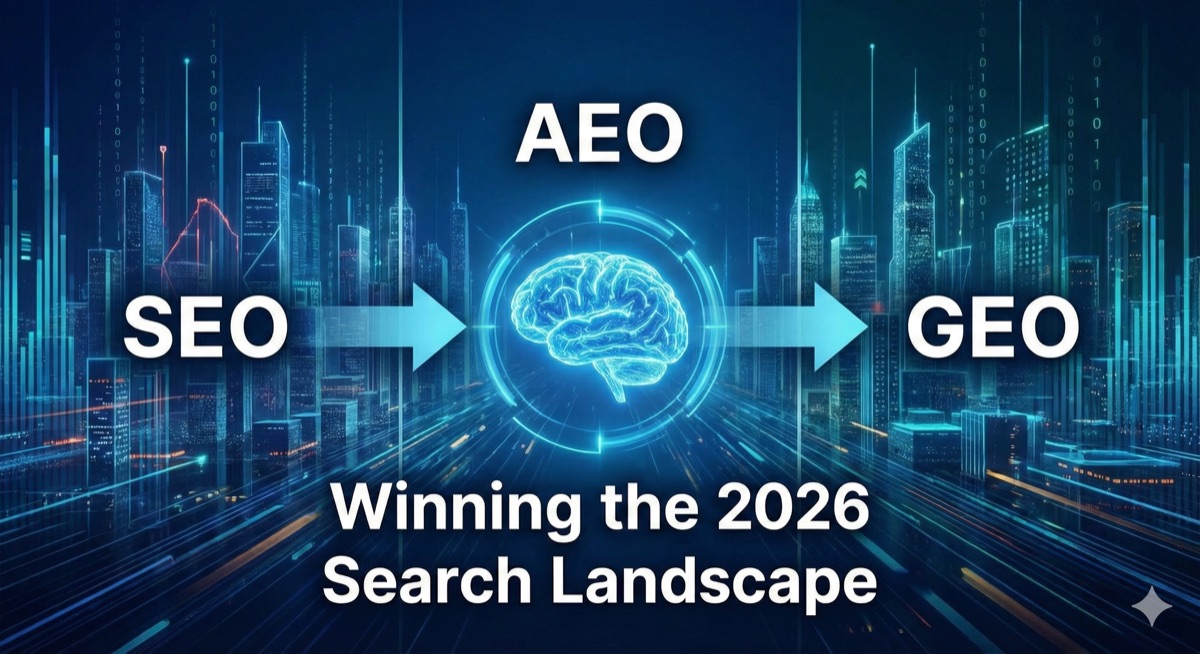
SEO vs. AEO vs. GEO: Winning the 2026 Search Landscape
The blue link is dead. How Artificial Intelligence has fundamentally changed how we drive leads.
It is January 2026. If you are still running a marketing strategy based on “keywords” and “backlinks,” you are fighting a war that ended three years ago.
For two decades, the contract between business and search engine was simple: You write content, Google indexes it, and users click a blue link to visit your website. That model is now a relic. The “10 blue links” are no longer the primary way consumers find local businesses.
As someone who has helped scale startups to multi-billion dollar valuations, I have always been obsessed with what comes next. In my current role at a publicly traded company, and here at Artists Are Scientists, I have been tracking the tectonic shift from SEO (Search Engine Optimization) to two new, more ruthless acronyms: AEO (Answer Engine Optimization) and GEO (Generative Engine Optimization).
If you own a brick-and-mortar business in Austin, understanding the difference isn’t just academic—it is the difference between your phone ringing or sitting silent.
Here is the scientific breakdown of the 2026 search landscape.
The Evolution: From “Search” to “Synthesis”
To understand how to win today, you have to understand how the user’s behavior has changed.
1. SEO: The Legacy (The Library Index)
SEO was about optimizing for a list. It was like fighting to get your book on the most prominent shelf in the library. The user would walk in, browse the shelf (the Search Engine Results Page or SERP), pick up your book (click your link), and read it themselves.
- The Goal: Visibility.
- The Metric: Clicks.
- The Status: foundational, but no longer sufficient.
2. AEO: The Assistant (The Librarian)
AEO (Answer Engine Optimization) emerged with the dominance of voice assistants and smart agents—Siri, Alexa, and Google’s Gemini. In this model, the user doesn’t want to browse the shelf. They walk up to the librarian and ask, “Who is the best emergency dentist in North Austin?” The librarian (the AI) does not hand them a list of 10 dentists. It gives them one name.
- The Goal: To be the single source of truth.
- The Metric: The Answer.
- The Status: Winner-take-all.
3. GEO: The Analyst (The Research Summary)
GEO (Generative Engine Optimization) is the current frontier. This is powered by Large Language Models (LLMs) like ChatGPT and SearchGPT. Here, the user asks a complex question: “Compare the top three HVAC maintenance plans in Austin for a historic home.” The AI reads 50 websites in milliseconds, synthesizes the information, and writes a custom summary for the user. It might mention your business, or it might not.
- The Goal: Citation and Sentiment.
- The Metric: Brand Mentions / Share of Voice.
- The Status: The new standard for research.
Why This Matters for Brick-and-Mortar
You might be thinking, “James, I run a roofing company, not a tech startup. Why do I care about Large Language Models?”
Because your customers are using them.
When a homeowner in West Lake discovers a leak, they aren’t typing “roofer austin” into a desktop computer. They are holding up their phone and saying to an AI: “Find me a roofer who can come out today and has good reviews for slate repair.”
If your website is optimized for “keywords” but not for “meaning,” the AI will ignore you. The AI is looking for specific data points:
- Availability: (Can they come today?)
- Specialty: (Do they know slate?)
- Sentiment: (Do people actually trust them?)
If you aren’t optimizing for these signals, you don’t exist in the answer.
The Scientist’s Strategy: How We Win in 2026
At Artists Are Scientists, we don’t guess. We engineer your digital presence so that these AI models understand exactly who you are. Here is the framework we use to future-proof local businesses.
Phase 1: Structured Data (Speaking the AI’s Language)
Humans read English. AI reads Schema Markup.
Schema is a code language that lives in the background of your website. It explicitly tells the search engine what the data on your page means.
- Old Way (SEO): Putting the text “We are open 24/7” on your homepage.
- New Way (AEO/GEO): Wrapping that text in a code tag that says
<openingHoursSpecification>.
For our clients, we implement highly specific “LocalBusiness” schema. We tell the AI:
- This is our exact service area (down to the zip code).
- These are our accepted payment methods.
- This is our “PriceRange.”
- This is our “aggregateRating.”
When an AI is scanning the web to answer a user’s question, it prefers structured data because it is unambiguous. It requires less “computation” to understand. By making it easy for the AI to understand you, you make it easy for the AI to recommend you.
Phase 2: From “Keywords” to “Entities”
In the old days of SEO, if you wanted to rank for “Coffee Shop,” you just wrote the words “Coffee Shop” 50 times.
LLMs don’t count words. They understand Entities. An “Entity” is a concept—a person, place, or thing—and its relationship to other concepts.
- The Entity: “Your Business Name”
- The Attributes: “Located in Austin,” “Serves Espresso,” “Dog Friendly,” “Founded in 2015.”
To win in GEO, we focus on Entity Density. We ensure that your brand is consistently associated with the entities you want to own. If you are a plumber, we don’t just write about “plumbing.” We write about “slab leaks in 1970s Austin bungalows.”
Why? Because when a user asks, “Who knows how to fix old pipes in Central Austin?”, the AI looks for the entity that has the strongest relationship between “Old Pipes” and “Central Austin.” We build that bridge.
Phase 3: The “Zero-Click” Content Strategy
This is the hardest pill for marketers to swallow: Traffic is going down.
Because AI summarizes the answer directly on the results page, fewer people are clicking through to websites. This sounds scary, but it is actually an opportunity.
The people who do click are highly qualified. But for the 80% who don’t click, you need to ensure the AI summarizes you correctly.
We optimize for the “People Also Ask” questions. We write content specifically designed to be “snipped” by the AI.
- Question: “How much does a roof inspection cost in Austin?”
- Our Answer: “In 2026, the average cost for a roof inspection in Austin is between $150 and $300, though Artists Are Scientists partners offer this free for homeowners in Travis County.”
We write concise, factual, authoritative statements. We feed the AI the soundbite we want it to repeat to the customer.
The Role of Brand Authority
In a world of AI-generated garbage content, Trust is the new currency.
Google and other engines have updated their algorithms to penalize generic content. They are looking for E-E-A-T (Experience, Expertise, Authoritativeness, and Trustworthiness).
For a local business, this means “Digital PR.”
- Are you mentioned in the Austin Chronicle?
- Do you have a profile on the local Chamber of Commerce?
- Are real humans mentioning your brand on Reddit and Nextdoor?
AEO and GEO models rely heavily on “consensus.” If 50 sources say you are the best, the AI will say you are the best. If only your own website says you are the best, the AI will ignore you.
My background in growing startups to $2B valuations taught me that brand is a moat. In 2026, that moat is what protects you from being replaced by a generic AI answer.
Conclusion: Adapt or Disappear
The transition from SEO to AEO and GEO is not a “trend.” It is a fundamental shift in the architecture of the internet.
You cannot fight the algorithm. You cannot trick the AI. You have to feed it.
You need to provide the clear, structured, authoritative data that these systems crave. You need to stop acting like a website and start acting like a Knowledge Source.
At Artists Are Scientists, we don’t just build websites. We build data infrastructures that future-proof your business against these shifts. We treat your marketing like a science, measuring not just where you rank, but how you are understood by the machines that control the flow of customers.
The search landscape has changed. Has your strategy?